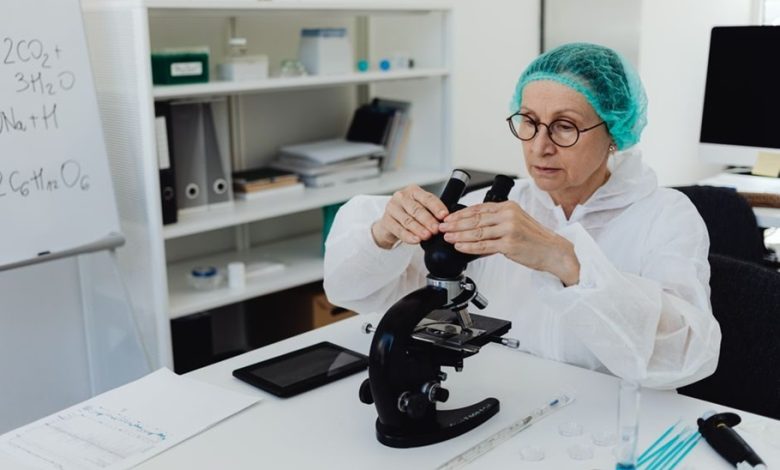
When a research result looks contaminated, the first instinct is often to question the compound. Was the batch impure, was the supplier’s documentation wrong, was there something in the vial that shouldn’t have been there. The contamination-control literature tells a more uncomfortable story: a large share of contamination events trace back to handling technique in the lab, not to anything wrong with the material as it arrived.
Key Takeaways
- Published reviews of laboratory contamination find that handling technique, not raw material quality, accounts for a substantial share of contamination incidents in research settings.
- Mycoplasma and other microbial contamination in cultured systems is frequently traced to shared equipment, reagent cross-contact, or lapses in sterile handling rather than to the biological material itself.
- Aseptic technique is a set of specific, learnable behaviours, not a general aspiration, and reviews of the practice describe it as a discipline with identifiable failure points.
- A diluent’s own documented quality does not protect against contamination introduced after the container is opened, which is why post-opening handling remains the research group’s own responsibility.
- Tracking where a contamination event actually occurred, rather than assuming the source material, is the step that turns an isolated bad result into an actionable process fix.
Working through where contamination actually originates changes where a research group should spend its attention when something goes wrong.
Why Contamination Investigations Default to the Wrong Suspect
It is a natural instinct to suspect the newest or least familiar variable in an experiment when a result looks off, and a peptide sourced from an external supplier is often exactly that variable. But a review of mycoplasma contamination in cell culture work found that the sources of contamination are frequently mundane and procedural: shared incubators, reused pipette tips, aerosol transfer between open containers, and technique lapses that have nothing to do with the quality of any single reagent introduced into the system.
This matters because an investigation that starts and ends with “was the material contaminated” can miss the actual point of failure entirely, leaving the underlying procedural risk in place for the next experiment.
Gloved hands preparing to access a small vial on a stainless steel tray
Aseptic Technique as a Specific Discipline, Not a General Intention
Aseptic technique is often treated as a vague standard everyone assumes they are already meeting. The literature on the subject describes something narrower: a specific sequence of behaviours around surface disinfection, container handling, and minimising open-air exposure time, each of which has an identifiable failure mode if skipped or rushed.
Most contamination events have a specific, identifiable point of failure. The uncomfortable part is that it is rarely the material that arrived in the post.
The UK Health and Safety Executive’s guidance on controlling biological agents in the workplace, HSG258, sets out the same underlying logic from a different angle: containment and contamination risk concentrate at specific handling steps and access points, rather than being evenly distributed across an entire procedure, which is why the guidance focuses so heavily on technique at those specific points rather than treating cleanliness as a single blanket standard.
A rack of clean test tubes prepared ahead of laboratory analysis
What This Means for Diluent and Container Handling Specifically
A diluent’s documented quality, however well verified, describes the product as it left manufacturing. It says nothing about what happens after a research group opens the container and begins drawing from it across multiple uses, which is precisely the stage where the contamination-control literature locates most of the risk. Container access technique, storage conditions between uses, and how consistently a clean access point is maintained all sit entirely within the research group’s own procedural control, independent of anything the supplier did or documented.
This is also why a preservative in a diluent inhibits bacterial growth rather than eliminating the need for careful handling. A preservative slows contamination that does occur; it does not prevent poor technique from introducing it in the first place.
Building a Contamination Log Into Routine Practice
A practical response does not require a formal quality system. Recording which container, which batch, and which handling step preceded an unexpected result gives a research group an actual dataset to look back through rather than a vague sense that “something might have gone wrong.” Over time, that log tends to surface a small number of recurring weak points, whether that is a specific piece of shared equipment, a particular access technique, or a step that gets rushed under time pressure.
research peptides supplier UK Peak Peptides supplies its diluent products with batch documentation covering the material as manufactured, which gives a research group a fixed reference point when something in the eventual investigation needs to be ruled in or out.
Researcher in full protective clothing working within an enclosed cleanroom setup
Treating contamination as a procedural question first, and a material question second, is the approach the published evidence actually supports, even though it runs against the instinct to blame the newest variable in the room.
Where Shared Equipment Fits Into the Picture
Shared laboratory equipment deserves particular attention in this framework, because it is often the least scrutinised part of a contamination investigation. Incubators, refrigerated storage, and communal pipette sets used across multiple research groups or multiple projects within the same group carry a structurally higher contamination risk simply because more hands and more open containers pass through the same space. A contamination-control review focused on cell culture settings specifically flags shared equipment as a recurring, identifiable source, distinct from either the reagents used or the individual researcher’s own technique.
This does not mean shared equipment should be avoided; it usually cannot be, for practical and budgetary reasons common to most research settings. It means that when a contamination log is being kept, which piece of shared equipment was involved is worth recording alongside the batch and handling step, because patterns at the equipment level are exactly the kind of recurring weak point a short log is designed to surface.
A Habit That Pays Off Precisely When It Is Needed
None of this changes anything about an ordinary, uneventful day of lab work. It changes what happens on the day a result looks wrong and a research group needs somewhere concrete to start looking. Without a contamination log, that investigation defaults to guesswork or, worse, an unexamined assumption that the supplied material was at fault. With one, it becomes a short, specific list of candidate causes that can actually be checked and ruled out systematically.
Frequently Asked Questions
Is contamination usually caused by the material itself or by lab handling?
Reviews of laboratory contamination, particularly in cell culture settings, consistently find that handling technique, shared equipment, and procedural lapses account for a substantial share of incidents, rather than the raw material as supplied.
What is aseptic technique, specifically?
A defined set of behaviours around surface disinfection, container access, and minimising open-air exposure time, each with its own identifiable failure point if skipped, rather than a general aspiration toward cleanliness.
Does a preservative in a diluent remove the need for careful handling?
No. A preservative such as benzyl alcohol inhibits bacterial growth that does occur after a container is opened, but it does not prevent contamination from being introduced by poor technique in the first place.
Where does the contamination-control literature say most risk concentrates?
At specific handling steps, particularly container access points and equipment shared between procedures, rather than being spread evenly across an entire experiment.
What is the simplest way for a research group to start reducing contamination risk?
Logging which container, batch, and handling step preceded any unexpected result, which over time tends to surface a small number of recurring weak points that can be addressed directly.
Sources
- Mycoplasma contamination of cell cultures: incidence, sources, effects, detection, and elimination, Molecular Biology Reports
- Controlling Biological Agents, HSG258, Health and Safety Executive
- Guideline on the Quality of Water for Pharmaceutical Use, European Medicines Agency